
Guide · New doors & clearance
Will the boat fit? Garage door clearance, measured properly
Toronto grew up around its foreshore, its jetty and its boat clubs, and it still shows on the driveways: tinnies, half-cabins, camper trailers, the box trailer that does the tip runs. Which makes one question close to universal when a new door gets talked about here. Will it fit under? The honest answer is that "fit" is decided by four different measurements, and the one printed on the door brochure is none of them.
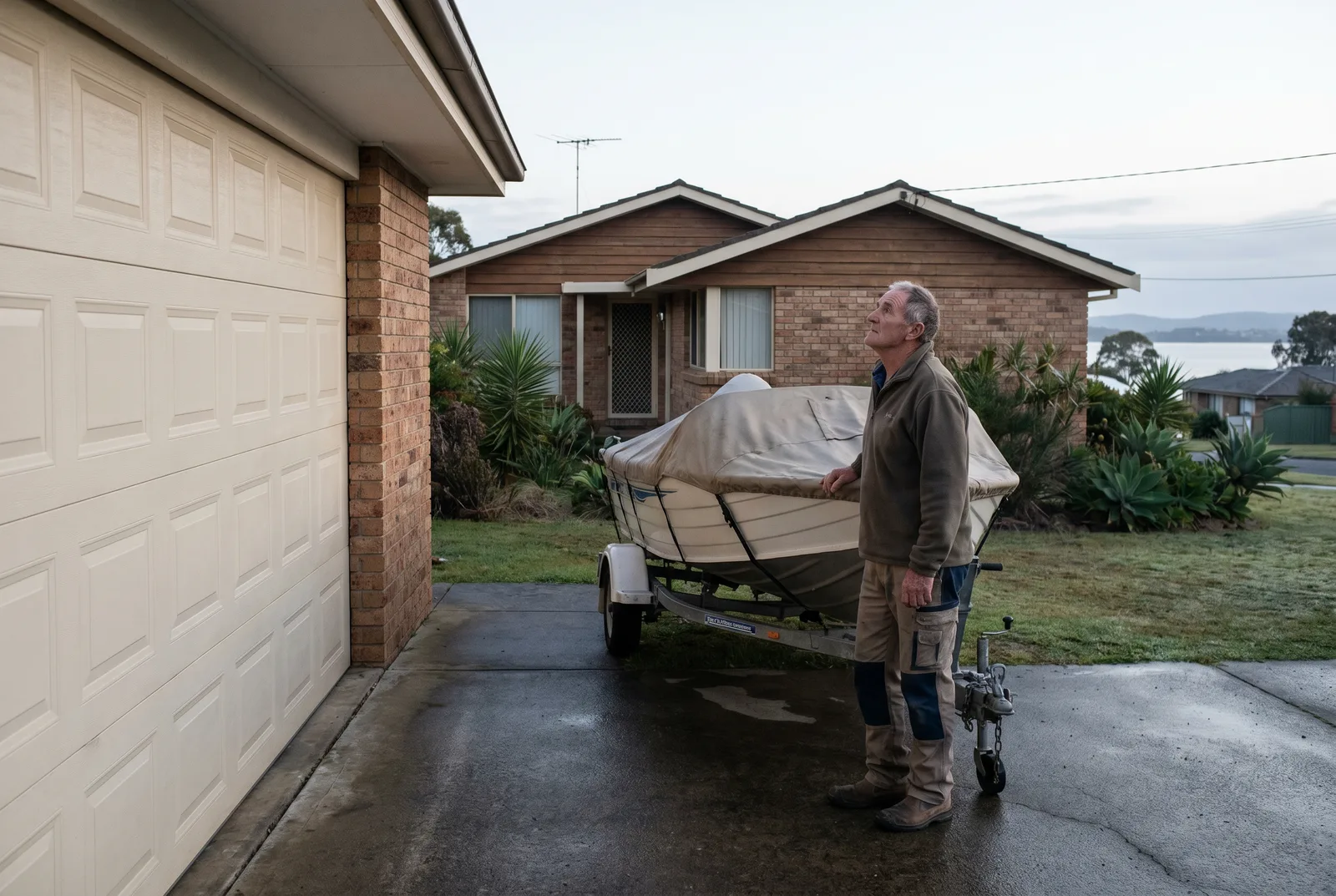
The opening is not the hole you drive through
Start with the distinction that catches nearly everyone. The opening height is the structural hole in the wall, lintel to floor. The drive-through height is the clear space actually available once a door, its tracks and its opener are installed and the door is open, and it is always less than the opening unless the door system is chosen to protect it.
How much less depends on the door type. A standard-lift sectional needs roughly 300 to 400 millimetres of headroom above the opening for its tracks and curtain, and when open, the door itself lies in that zone; if the headroom isn't there, installers drop the tracks lower into the opening, and the drive-through shrinks. A roller door is kinder, needing only around 200 to 250 millimetres for its drum, but the rolled curtain still hangs at the top of the opening. An opener rail down the centre line can shave more again, right where an aerial or a rocket launcher rides. None of this is a flaw; it's geometry, and it's exactly the kind of thing a measure visit exists to resolve.
The four numbers that decide it
- The load's true height. The boat's highest hard point as it actually travels: canopy bows, aerials folded or not, the outboard tilted, measured from the ground while it's on the trailer. Not the hull spec from the brochure.
- The drive-through height. Clear space under the open door system, at the point the highest part of the load passes it. This is the number that has to win, with margin.
- The width between the jambs. Trailer mudguards and folded mirrors are wider than the boat, and reversing eats width. A fit with fingers to spare each side is a scrape by winter.
- The approach angle. A sloping driveway pitches the load as it enters. On the patch's steeper streets, the bow can rise just as it reaches the lintel, and a fit measured on the flat fails on the hill. This one is pure western-shore: plenty of our garages sit below road level.
What can be done when it doesn't fit
Plenty, and the options are honest ones. High-lift track configurations carry a sectional's curtain higher above the opening, buying back drive-through where the garage has ceiling to spare. A roller door can be the right call where headroom is tight. Sometimes the answer is as simple as re-routing an opener rail or a different opener style. And sometimes the honest finding is that the door isn't the constraint at all, the opening is, and making it taller is builder's work before it's door work. If that's the reading, we'll say so plainly rather than sell you a door that almost fits.
What to have ready before you ask
You don't need to measure anything dangerous, and you don't need to be precise; that's what the measure visit is for. But three rough numbers make your first message ten times more useful: the load's ballpark height on its trailer, the present opening's rough width and height, and whether the drive slopes. Put them in the enquiry form and the conversation starts halfway finished.
One caution, in the same spirit as everything we publish: if checking your existing door means operating one that's misbehaving, heavy, crooked, grinding, read the half-lift guide first. A clearance question is never urgent enough to argue with an out-of-balance door.
The words, so we're speaking the same language
- Headroom
- The space between the top of the opening and the ceiling, where a door's tracks, curtain or drum live. Roughly 300 to 400 millimetres for a standard-lift sectional, around 200 to 250 for a roller drum, more comfortable is always better.
- Drive-through height
- The clear height actually available under the installed, open door system. The number that decides whether the boat comes inside or winters under a tarp.
- High-lift tracks
- A sectional track configuration that carries the open curtain higher above the opening, protecting drive-through height where the garage has the ceiling for it.
- Approach angle
- The pitch a sloping driveway gives a load as it enters. The reason a fit on paper can still touch on the hill.
The measure visit is free, and it answers all four numbers in one go, boat on the trailer if you like.
Tell us about the door
Say what it's doing in your own words. Gone heavy, off its track, slammed shut, or just due for a look, it all makes sense to us. You'll get a call back on the number you leave, and a plain answer when we're standing in front of it.
We don't publish a phone number while the books are this new. The form is the front door, and it goes straight to a person, not a queue.
Prefer a bigger form, or want to attach a photo? Use the full enquiry page.

Received, and holding.
Your enquiry is in. You'll get a call back on the number you left. If the door is stuck part-open in the meantime, leave it where it sits and keep people and cars clear.